Essay Guidelines and Your Red Mittens

vision can change the world

I promised to post some guidelines for those who are writing an essay to win a contest, especially the Inn in Maine.  Although I will be personally working with ten people on this contest I have had so many inquiries that I thought to help the best I could by including on my blog some thoughts for writing a 200 word essay.  There is wisdom included in the guidelines below from writers other than myself who have learned a few things about writing a short essay of this kind.

Feel free to post questions and please feel free to send me a bit about your story to share with my readers.  We can all use inspiration.

Dreaming big is what we should all be doing and without restraint.  I hope this helps to dream even bigger.

Essay Writing Information From Maya Christobel

Here are some tips on approaching writing your essay. Over the years I have gathered lots of great advice and experience, which I will jot down for you to help you launch your essay.


  • Short is all that much harder than long, but don’t worry. Write as much as you want and then you will slash a burn what is not essential.
  • Do not hurry. Allow the muse to whisper in your ear. If you hurry your mid will be in the driver seat and that will not make for a great essay.
  • Pay attention to what you might be afraid to say, what you were dreaming the night before you work on your essay, pay attention to your intuition and instinct and particularly pay attention to the visual images you have in your mind.
  • This is not a test. Write instinctively first, not like an English major taking a test. Thinking you need to do it “right” will never help you “write”.


Tell a story about you and about your dream: Be specific: The more personal the better. Think of your own experience, work, and family, and tell of the things you know that no one else does. Find the unique points of your dream and focus on them. Instead of saying something about loving your parents and wanting to help them run a B+B, say more than that: Say why you love them, what makes them so special and the perfect people to realize their dream. Your story need not be heart-warming or gut wrenching—it can even be funny—but it has to be real.


Be personal: Write in words and phrases that are comfortable for you to speak. I recommend you read your essay aloud to yourself several times, and each time edit it and simplify it until you find the words, tone, and story that truly echo your belief and the way you speak. In fact take your iPhone or a recorder and simply tell your story and then play it back many times. This will help you focus on what feels right, what stands out and what may not fit.  Tell your story first to a best friend and see what she or he is moved by.


Consult your Heart: When you are limited to 200 words, which is not quite one page you will be doing a lot of thinking about what you need or want to write. My advice is to please write from your heart first. Do not focus on grammar or spelling or word count. Make sure you are answering the following questions:


  • Why does owning this Inn inspire you?
  • How would it change your life AND others.
  • What particular experience do you have that helps you run an Inn.
  • Why are you the best candidate? What makes you Unique?


Then Lead Your Essay with a Good Hook, this is most important.

When it’s time to start writing your essay contest entry, remember that the first sentence is the most important of all. If you can start with a powerful, intriguing, moving, or hilarious first sentence, you’ll hook your readers’ interest and stick in their memory when it is time to pick winners. Remember you are competing against 7500 other dreamers so that first sentence needs to stand out.

Write Your First Draft Essay

Now is the time to get all of your thoughts down. At this stage, it’s not necessary for everything to be perfectly polished; you’re just setting down the bones of your final essay contest entry. Try to hit the points you most want to communicate. If your essay is running longer than the word count limit, don’t worry about it at this stage, I will help you trim the fat.

 red mittens

Keep an Eye Out for “Red Mittens”

This is something I learned along the way that has been indispensable. The “red mittens” idea has to do with making sure you have something so unique and visual in the essay that they will remember you out of the crowd. It is like planting an Easter egg in the bushes. Here is a great piece of information.

Excerpt from Sandra Grauschopf: Contests & Sweepstakes Expert

“In her fantastic book, The Prize Winner of Defiance, Ohio, Terry Ryan talked about how her mother used “Red Mittens” to help her be even more successful with contest entries. To quote from the book:

“The purpose of the Red Mitten was almost self-explanatory — it made an entry stand out from the rest. In a basket of mittens, a red one will be noticed.”

Among the Red Mitten tricks that Evelyn Ryan used were rhyme, alliteration, inner rhyme, puns, and coined words.

While Evelyn Ryan mostly entered jingle and ad-type contests, the Red Mitten theory can be used to make any essay contest entry stand out. Your Red Mitten might be a clever play on words, a dash of humor, or a heart-tugging poignancy that sticks in the judges’ minds.”


Then Revise Your Essay for Flow 

Once you have written the first draft of your essay contest entry, look it over to ensure that it flows smoothly. I will be helping you all along the way to make sure that you say what you need in compelling ways and that it flows. Is your point well made and clear? Does the essay flow smoothly from one point to another? Do the transitions make sense? Does it sound good when you read it aloud? Remember this is a final piece of writing and at the beginning you just need to get all your feelings and thoughts on paper even if it is five pages.

At this point you and I will cut out extraneous words and make sure that you’ve come in under the word count limit.

In Stephen King’s book which I believe is one of the best out there, On Writing, he talks about a rejection notice he once received that read: “Formula for success: 2nd Draft = 1st Draft – 10%.” In other words, the first draft can always use some trimming to make the best parts shine.


Now Put Your Writing Away

When you have a fairly polished first draft of your essay contest entry, put it aside and don’t look at it for a little while. If you have time before the contest ends, put your essay away for at least a week. Let your mind mull over the idea subconsciously for a little while and see what else bubbles up.

I can’t tell you the number of times I’ve sent in an entry and then thought of something that I should have added to make it perfect. Letting your entry simmer in your mind and heart gives you the time to come up with these great ideas before it’s too late.


Finally, Revise Your Essay Again and Again

Now is the time to put the final polish on your essay contest entry. Have you said everything you wanted to say? Have you made your point? Does the essay still sound good when you read it aloud? Can you tighten up the prose by making any additional cuts in the word count? And let people you know read it. They will have great ideas. You don’t have to use them but you may want to.

If possible, this is a good time to enlist the help of friends or family members. Read your essay aloud to them and check their reactions. Did they smile in the right parts? Did it make sense to them?

And ask a friend to double-check your spelling and grammar. Even your computer’s spell check programs make mistakes sometimes, so it’s helpful to have another person read it over. I will do that with you but you will want to have another person in the wings that is great at this sort of thing.

The Magic Bullet: The Power of Your Intention

What I encourage you to do is to not focus on winning but focus on learning more about yourself, your dream, more about listening to your “deep voice” and allowing yourself to be vulnerable and honest. You can do that with a tiny story, with humor or with a quote.

And I encourage you to do the envisioning that will make your intention to win the Inn a reality. Cut out a photo of the Inn, paste it above where you write. Do a daily visualization of you owning the Inn, people coming, joy happening, you feeling successful and happy. This is your most powerful writing tool

Happy writing!

I have a dream

Go back

Your message has been sent

Warning
Warning
Warning
Warning

Warning.

Procrastination is the Name of the Game

procrastination

“The thing all writers do best is find ways to avoid writing.” ― Alan Dean Foster

“Like most writers, I am an inveterate procrastinator. In the course of writing this one article, I have checked my e-mail approximately 3,000 times, made and discarded multiple grocery lists, conducted a lengthy Twitter battle over whether the gold standard is actually the worst economic policy ever proposed, written Facebook messages to schoolmates I haven’t seen in at least a decade, invented a delicious new recipe for chocolate berry protein smoothies, and Googled my own name several times to make sure that I have at least once written something that someone would actually want to read. Lots of people procrastinate, of course, but for writers it is a peculiarly common occupational hazard. One book editor I talked to fondly reminisced about the first book she was assigned to work on, back in the late 1990s. It had gone under contract in 1972.” Megan Mcardle

I teach writing workshops and classes and it is inevitable to hear a writer say, under their breath and hoping no one will hear, that they in fact battle a million and one distractions in order to sit down and become a productive writer. Then whether the battle is won or lost, what the end product generates is self doubt, and self criticism. Well let’s all just stop that. The common issues regarding procrastination for writers are captured by the quote above made by Megan Mcardle.

But, the problem of procrastination can be as simple as working from home and the phone ringing and jumping up to answer it, putting that load of laundry in, having to get up and walk the dog or the most common issue being the uncertainty about what you are writing and welcoming every single little tiny distraction that exists in order to avoid the fear, the lack of clarity or the horrible feeling of being stuck.

What we use to procrastinate must serve us in some important way. Procrastination is what is called an “avoidance technique” and it is your job as a writer to look it square in the eye and fess up to what you might be avoiding. In the end, procrastination is all about being uncertain about your self as a writer. Whether it is about inspiration, self concept, constantly comparing your writing to others or the loop that is going all the time in your head that says something like this: “what the hell are you thinking writing this book?” the ultimate outcome is a kind of stalling out and waiting for a magical elixir. But, procrastination comes in many shapes and sizes.

The French novelist Sidonie-Gabrielle Colette who wrote Gigi, used her French bulldog, Souci, to procrastinate writing. She would pluck fleas from Souci’s back and hunt for them in her fur until the grooming ritual prepared her to move on to other procrastination techniques like cuddling with Souci and swatting flies. Only then would Colette begin to work.

Graham Greene, who wrote The Quiet American, needed a sign from above to begin working on a piece. Obsessed with numbers, the English playwright and novelist needed to see a certain combination of numbers by accident in order to write a single word. He would spend long periods of time by the side of the road looking at license plates and waiting for the hallowed number to appear.  Now that is navigating by the sigs and by coincidence.

Wherever he traveled, Charles Dickens decorated his desk with nine objects. The bronze toads, green vase, and the statuette of an eccentric dog salesman surrounded by his pups comforted Dickens when he hit a mental block, and helped him feel comfortable enough to work anywhere.  Now this is bordering on being Obsessive Compulsive but OCD has its place in history with a slew of famous writers.

Victor Hugo, who wrote novels like Les Miserables, did more than buy a new bottle of ink in preparation to write The Hunchback of Notre Dame. With a deadline looming, Hugo locked himself inside his house with nothing on but a knitted gray shawl that reached down to his toes. The uniform suited his productivity, and he completed the novel weeks ahead of the deadline.

Some people dream of lounging all day, but Truman Capote really did. His workday began in bed or on a couch where he would write on a notebook rested against his knees. He always kept cigarettes and whichever drink was appropriate for the time of day—coffee, tea, or sherry. Boy do I relate to this. Not the cigarettes and Martinis at the crack of dawn, but I get out of bed and put on my favorite tea at 6:30 am and then crawl back in bed with my laptop on my knees and write until 10am every morning. If I do not do this I am a basket case and cannot get my barring’s for the whole day. I put music on every time and listen to soundtracks of my favorite movies while I write. The theme from Bourne Legacy gets me every time.

So you are in good company. You are not odd or unusual in your procrastination. And in the end you need to make friends with a pattern that is one of the most frequent issues for a writer. Know that procrastination is just part of the job. Get over it when you can and then laugh at yourself the rest of the time. You will get to writing, you will finish and you will be done in your own good time.

“We are so scared of being judged that we look for every excuse to procrastinate.” ― Erica JongSeducing the Demon: Writing for My Life

Quantum Storytelling

Man-points-toward-galaxy-in-sc-32849888

I sat in a kind of stupor as the credits rolled, the crowd silently leaving the theater. I had a feeling that being in Oklahoma at the time, the majority of the moviegoers were baffled by what they had just seen. No one was talking, something had happened. I was the only one still in my seat. I had sat through three hours and two full bags of popcorn watching Interstellar. Not because Matthew Mcconaughey is beautiful or talented but because I knew that embedded in this film was far more than star power.

I am not going to review the movie here. But, I want to talk about how story can wake you up. Interstellar was written and directed by the Christopher Nolan who did Inception. Most of us know how it felt to watch that movie and witness something just outside of our grasp, but mesmerizing and intriguing enough to keep us glued to our movie seat. Interstellar was no different for me but far more powerful since it is a premier example of how story can change us at every level. I mean really change us.

That any filmmaker would attempt to take me into the heart of quantum physics and nudge me toward a new and more defined perception of time and space gets my attention. Flaws of moviemaking aside, I loved one particular thing about this story: That it revealed what the shift on our planet and in our own DNA as humans may be all about. And that is powerful.

I find myself gravitating to substance instead of the entertainment value of story. And Interstellar seemed to allow me to sink into the big questions of life, the unanswered questions, the heroic ones and the questions we all fear to really look into the heart of.   Questions of where do we come from, why are we here, what is god, are we alone in the Universe, what is beyond three dimensional existence, is there more than one Maya in the solar system and what does relativity and gravity have to do with everything? As for me, those are the only questions I am interested in.

So when I took the leap three months ago out of the world of psychotherapy and embraced what I truly love the most in life, I did so with the understanding that story would heal us as individuals and story would heal the planet in ways that are ineffable, illusive, complex and sometimes simply a mystery.

I held up a torch in my life to ask for stories to come to me. I held tight to my deep love and passion for stories of transformation, survival, hope and love as the greatest power in the Universe as I intended to write only these stories, and help others bring their amazing adventures and dreams into reality. I got far more than I bargained for. Gratefully.

People from all over the world are finding me in some of the most unusual ways. Phone calls and emails from those who suddenly feel ready to reveal secrets of the Universe only they have been entrusted with, stories of unparalleled heroism that will change lives and creative dreams and fantasies that speak to transforming our own natures from war to love, and from fear to magic.

I am pausing to allow myself to feel how very important each one of these stories are and how I can be a part of birthing weapons of mass love and power which is the medicine our planet needs. Medicine the storyteller needs as well, which will affect them on the deepest level imaginable and affect the lives of their families.

Storytelling is a sacred event. I cannot urge everyone enough to begin to see the stories that you have lived or imagined as sacred energy that you were entrusted with long before you were born.   You alone are the keeper of your own unique story of bravery, courage, pain and suffering, triumph of the spirit, love and lost love, finding god or becoming god.

The energy inherent in a great story or film creates a resonant response in our physical bodies, our thoughts and our hearts. That resonant energy begins a cascading shift and change in our own cellular nature. We are not only changed emotionally or intellectually when we read or watch an amazing story, we are changed energetically and physically. This is why I would always caution against the Horror and Death Film. We are changed in ways that only fear can accomplish when we subject ourselves to the images that these films provide in abundance.

And fear releases adrenaline and then fear becomes an addiction to the thrill of the adrenaline. In the end we are physically, emotionally and spiritually changed. The same can be said for the stories that we need far more: Stories of love and hope and courage. Stories of overcoming the unthinkable.

So, I am blessed to be given the opportunity to help any storyteller birth what is uniquely their primary and most powerful contribution to their legacy on this planet: A personal story that will resonate with the people who have simply been waiting for your story and just have not known it.

Later this week I will post under Screenplays the movies that are must sees and the books that should be movies. We all need food for the soul since our souls are under siege by technology and a planet in peril. Your story is a life raft, is a story to help each of us remember who we are, who we were born to be and who we have yet to become. Bravo to our brave storytellers.

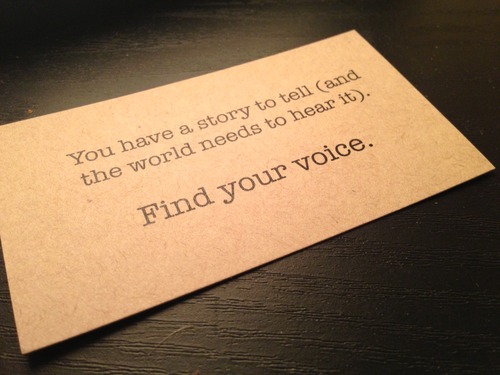
Find your voice